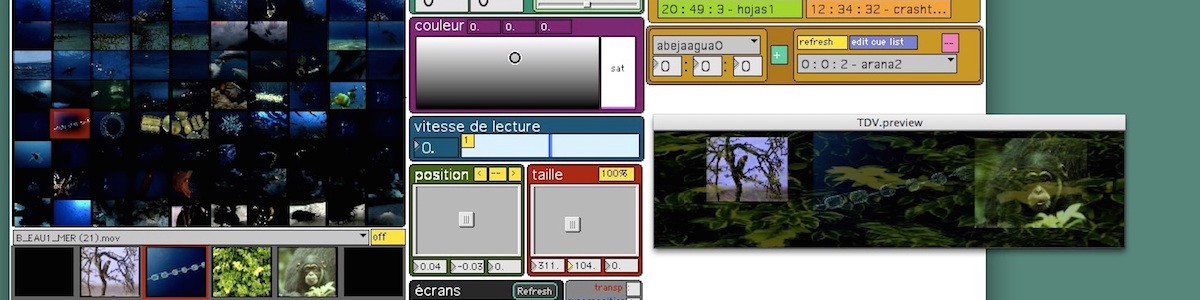
Development of a “radio-roulette” Max patch for the “Atelier de Création Radiophonique”. The application is receiving a set of live radio streams across Europe (from the amazing audio signal matrix at the Maison de la Radio, before it was all over network but still a patch thing!). The app then let one “launch” the roulette and is wheeling in a round-robin across the various radio streams.It was used live during the radio show, as a means of including random chunks of sounds aired in the European Union at that precise moment.
Client : Atelier de Création Radiophonique – France Culture
RADIO DAY : DÉSIRS D’EUROPE © Radio France
On the occasion of the “European Day of Culture and Radio”, France Culture’s “Atelier de Création Radiophonique” presents an exceptional live, multi-channel broadcast from studio 105 of the Maison de la Radio, and gives the floor to the “New Europeans” (i.e. the 10 new member countries of the Union) to identify their desires for Europe: what Europe do we want and how?
Conceived as a sonic journey through the radio universes of this new Europe, our program features Proto Radio in Cyprus, Vikkeradio in Estonia, Radio Petofi in Hungary, Lativijas Radio 1 in Latvia, Rtvslo 1 in Lithuania, Radio Malta in Malta, Radio Regina in Slovakia, Radio A1 in Slovenia, Radio 2 in Poland and Radio Vltava in the Czech Republic, and connects live to their programs broadcast in the same time slot as our program, namely from 10:45 p.m. until midnight.
This unique program/performance will be punctuated by reports (from Lithuania, Slovenia, Latvia, and Cyprus) and a series of testimonies gathered from French artists who have worked in one of these countries: Martine Franck (photographer) in the Czech Republic, Patrick Zachmann (photographer) in Hungary, and Eléonore de Montesquiou (visual artist) in Estonia—all contextualized by Bernard Stiegler (philosopher, director of IRCAM) and Yves Mény (political scientist and president of the European University Institute in Florence). No B-side.
Broadcast on Sunday, October the 16th, 2005, from 10:45 to midnight.
Listen to the archived podcast:
https://www.radiofrance.fr/franceculture/podcasts/atelier-de-creation-radiophonique-10-11/radio-day-desirs-d-europe-7311783