
Présentation de “The Brain Orchestra“, un instrument de sonification de l’activité neuronale développé en collaboration avec Sébastien Wolf, chercheur à l’Institut de Biologie de l’ENS.
C’est demain, durant les Journées d’Informatique Musicale, organisées cette année sur le campus de la Doua à Lyon, par le GRAME, l’AFIM, l’INRIA et l’INSA de Lyon.
Tags : #software
The Brain Orchestra @ CFA’2025
Présentation de “The Brain Orchestra“, un instrument de sonification de l’activité neuronale développé en collaboration avec Sébastien Wolf, chercheur à l’Institut de Biologie de l’ENS.
C’est aujourd’hui durant le CFA de la SFA – Société Française d’Acoustique sur le Campus Pierre et Marie Curie de Sorbonne Université.
AIM-Framework
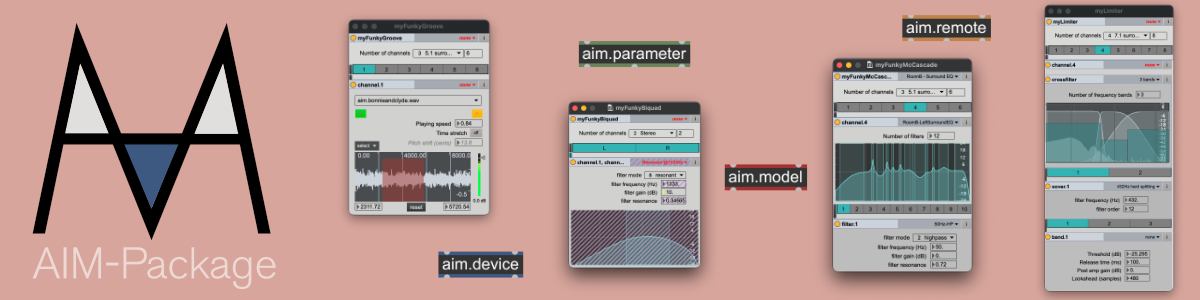
Designing a complete in-car audio experience requires rapid prototyping solutions in a complex audio configuration, bringing together different areas of expertise ranging from sound-design and composition, down to hardware protection, with every conceivable layer of audio engineering in-between, up to A-B comparisons setups for end-users perception evaluation in real demonstration vehicules.
The AIM project started as a request from the Active Sound eXperience team at Volvo Cars Company to meet such goals.To this end, it was decided to develop a framework on top of Max/MSP, so that dedicated audio processing modules could be easily created, with the ability to store presets for various configurations, and to take advantage of Max’s modular design to distribute the complexity of audio engineering among the various expert teams involved in the project.
The core part of the package (building blocks) was presented at the Sound and Music Conference (SMC’22) organized by GRAME in Saint Etienne, France.
Summary: https://zenodo.org/record/6800815
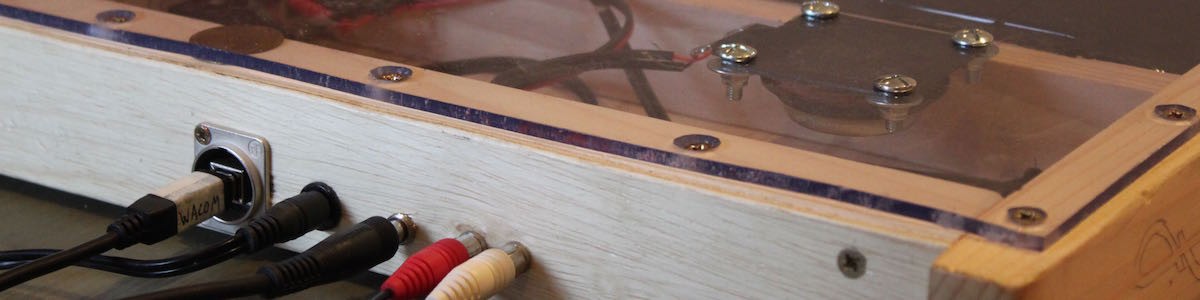
Filigramophone — a sound-enhanced pen tablet
John — the semi-conductor (Max version)
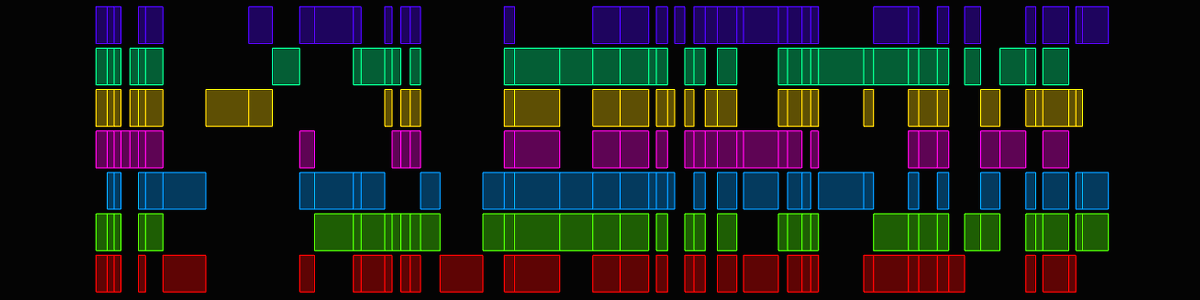
John, the semi-conductor.
John is an application meant for collective free improvisation, which was born out of the needs encountered in free improvisation practice with the Orchestre National Electroacoustique.
Namely, John was invented as a virtual companion to find stimulating answers for issues encountered in collective free improvisation, like precise timings for transitions between contrasting parts, articulations of large movements, or the proposal of unusual scores taking us off the beaten path.
It is made of two parts :
- a score editor which can generate random scores based on constraints and probablities defined by the user
- a real-time “conductor” displaying the score during live performance
Its name refers to both John Cage and John Doe.
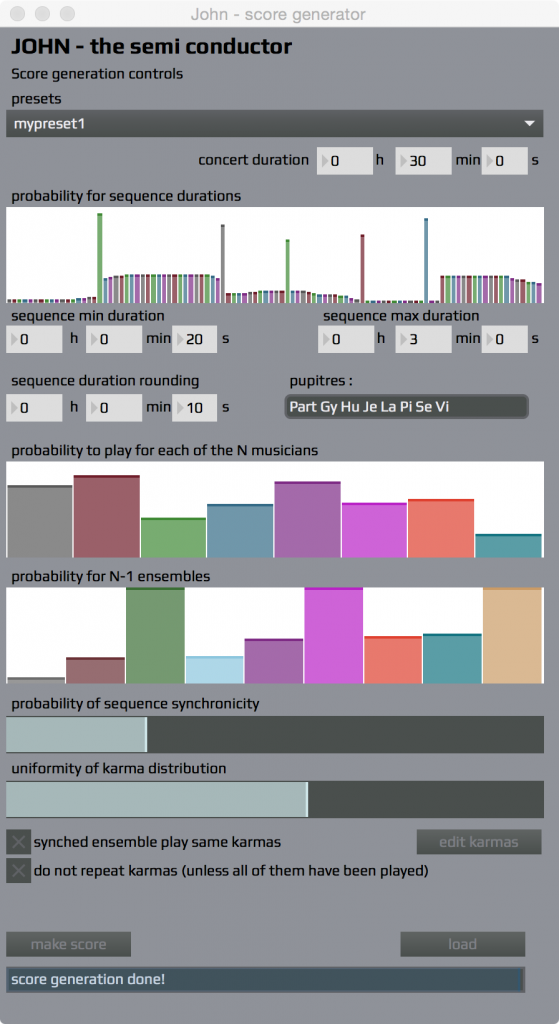
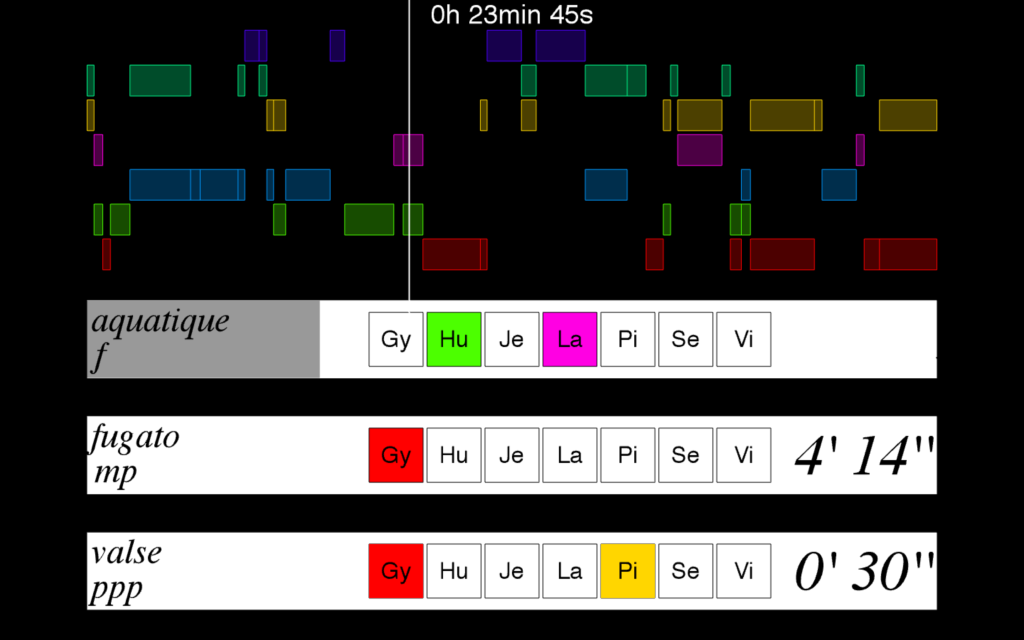
The original development was made with Max, then later reworked to a reactive web app.
filigram
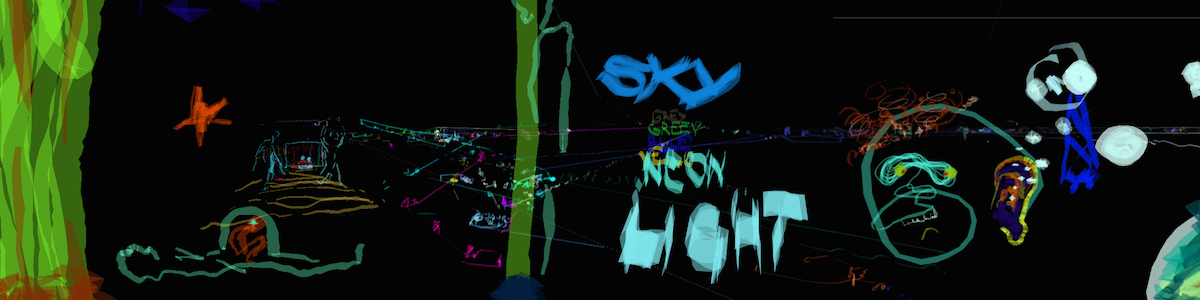
filigram is an app to draw filigrams.
filigram is an expressive tool based on drawing gesture, gathering on the same canvas doodles made by people of different cultures in various contexts.
Filigrams are hand-drawn drawings made on a 2D surface, in a 3D world. Thanks to computers memory, this virtual “sheet of paper” becomes infinitely wide and allows for navigating inside the drawings.
This app was made originally made as a public-space installation where people could share a collective experience of drawing on the same canvas. Perspectives on others’ drawings sometimes leads to graphical compositions that could only be seen from a specific point in the virtual space, somehow like the paintings by Felice Varini.
filigram was shown during:
– Art4Lux, Abbaye de Neumunster, Luxembourg (Lu), sept. 2007
– Net User Conference 2007 , Pleven Hovel, (Bg), july 2007
– in Istanbul (Tr), july 2007
– Mobile Studios , Batenberg Square, Sofia (Bg), june 2006
– TheUpgrade! Skopje (Mk), june 2006
– TheUpgrade! Sofia (Bg), june 2006
– … and in various unofficial venues in France, 2005/2007.
with support from:
Inter-Space Media Art Center
Pépinières européennes pour jeunes artistes.
Puce Muse
Originally developped with Max, Filigram has been implemented in Java/Processing for availability in the browser, and OpenFrameworks for iOS/android support. Now outdated, the code is being refactored before moving to an open source repository at GitHub. Please contact if interested in the meantime.

media
Radio roulette / Atelier de Création Radiophonique

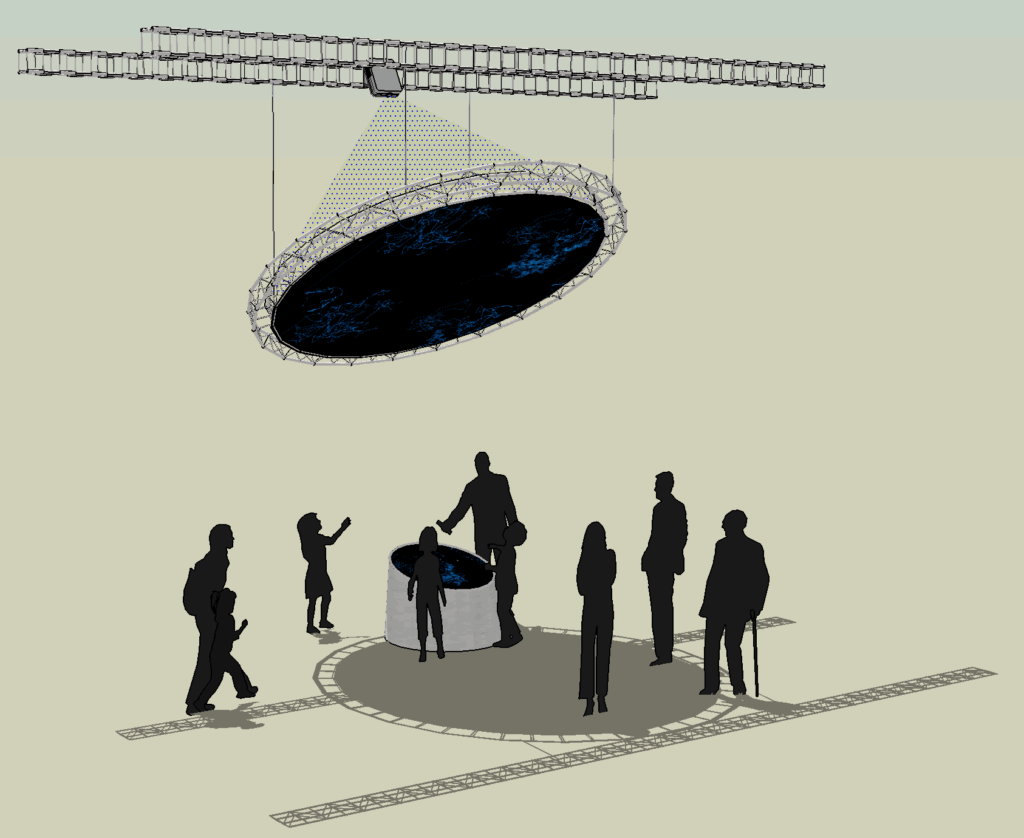
Development of a “radio-roulette” Max patch for the “Atelier de Création Radiophonique”. The application is receiving a set of live radio streams across Europe (from the amazing audio signal matrix at the Maison de la Radio, before it was all over network but still a patch thing!). The app then let one “launch” the roulette and is wheeling in a round-robin across the various radio streams.It was used live during the radio show, as a means of including random chunks of sounds aired in the European Union at that precise moment.
Client : Atelier de Création Radiophonique – France Culture
RADIO DAY : DÉSIRS D’EUROPE © Radio France
On the occasion of the “European Day of Culture and Radio”, France Culture’s “Atelier de Création Radiophonique” presents an exceptional live, multi-channel broadcast from studio 105 of the Maison de la Radio, and gives the floor to the “New Europeans” (i.e. the 10 new member countries of the Union) to identify their desires for Europe: what Europe do we want and how?
Conceived as a sonic journey through the radio universes of this new Europe, our program features Proto Radio in Cyprus, Vikkeradio in Estonia, Radio Petofi in Hungary, Lativijas Radio 1 in Latvia, Rtvslo 1 in Lithuania, Radio Malta in Malta, Radio Regina in Slovakia, Radio A1 in Slovenia, Radio 2 in Poland and Radio Vltava in the Czech Republic, and connects live to their programs broadcast in the same time slot as our program, namely from 10:45 p.m. until midnight.
This unique program/performance will be punctuated by reports (from Lithuania, Slovenia, Latvia, and Cyprus) and a series of testimonies gathered from French artists who have worked in one of these countries: Martine Franck (photographer) in the Czech Republic, Patrick Zachmann (photographer) in Hungary, and Eléonore de Montesquiou (visual artist) in Estonia—all contextualized by Bernard Stiegler (philosopher, director of IRCAM) and Yves Mény (political scientist and president of the European University Institute in Florence). No B-side.
Broadcast on Sunday, October the 16th, 2005, from 10:45 to midnight.
Listen to the archived podcast:
https://www.radiofrance.fr/franceculture/podcasts/atelier-de-creation-radiophonique-10-11/radio-day-desirs-d-europe-7311783