PANAM — accessible tools for digital art pedagogy

PANAM (Pédagogie artistique numérique accessible et multimodale) is a research and development project led by Puce Muse and concerned with the development and analysis of HCI strategies and tools for collective music practice with digital music instruments. It focuses on the accessibility of such tools for disabled people.

As part of the LAM team, several tools have been developed for the mapping, visualisation, and building of digital music instruments. They have been implemented as modules for the Meta-Mallette software (©PuceMuse), and are available as part of the LAM-lib, a software library for Max/MSP.

Publication

[pdf] Vincent Goudard, Hugues Genevois, Lionel Feugère. On the playing of monodic pitch in digital music instruments. Anastasia Georgaki and Giorgos Kouroupetroglou. ICMC/SMC 2014, Sep 2014, Athènes, Greece. National and Kapodistrian University of Athens, pp.1418, 2014.

Partners


LAM-lib — a Max package for digital luthery

The digital lutherie toolkit you need.

LAM-lib is a toolkit for Max/MSP providing all kind of useful goodies you need when building digital music instrument with Max. I started it during my work at the Lutherie Acoustique Musique lab. It is distributed under LGPL licence so that you can check it, fork it, buy it, sell it, use it, break it, fix it, trash it…etc. Just credit it.

Get it from GitHub.

John — the semi-conductor (Max version)

John, the semi-conductor.

John is an application meant for collective free improvisation, which was born out of the needs encountered in free improvisation practice with the Orchestre National Electroacoustique.

Namely, John was invented as a virtual companion to find stimulating answers for issues encountered in collective free improvisation, like precise timings for transitions between contrasting parts, articulations of large movements, or the proposal of unusual scores taking us off the beaten path.

It is made of two parts :

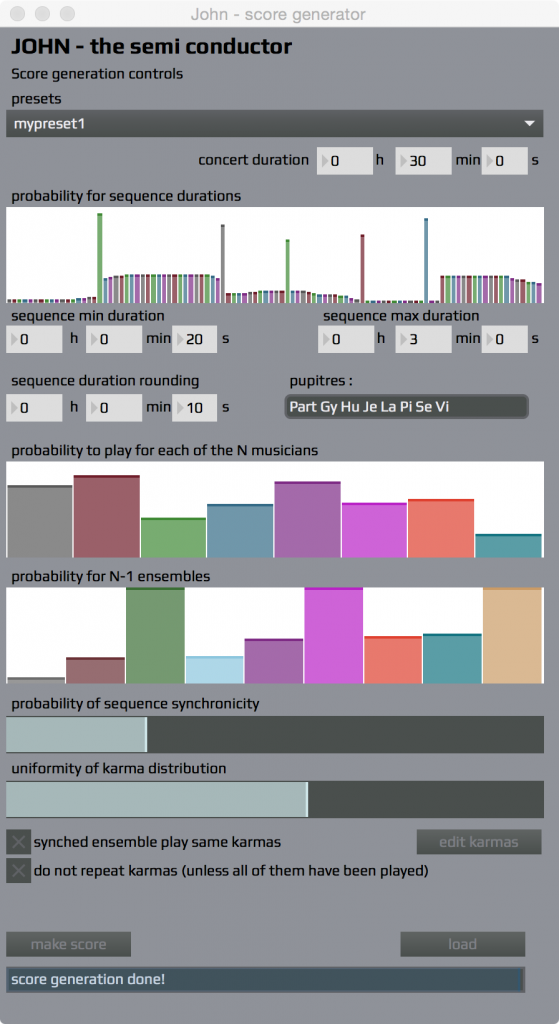
  • a score editor which can generate random scores based on constraints and probablities defined by the user
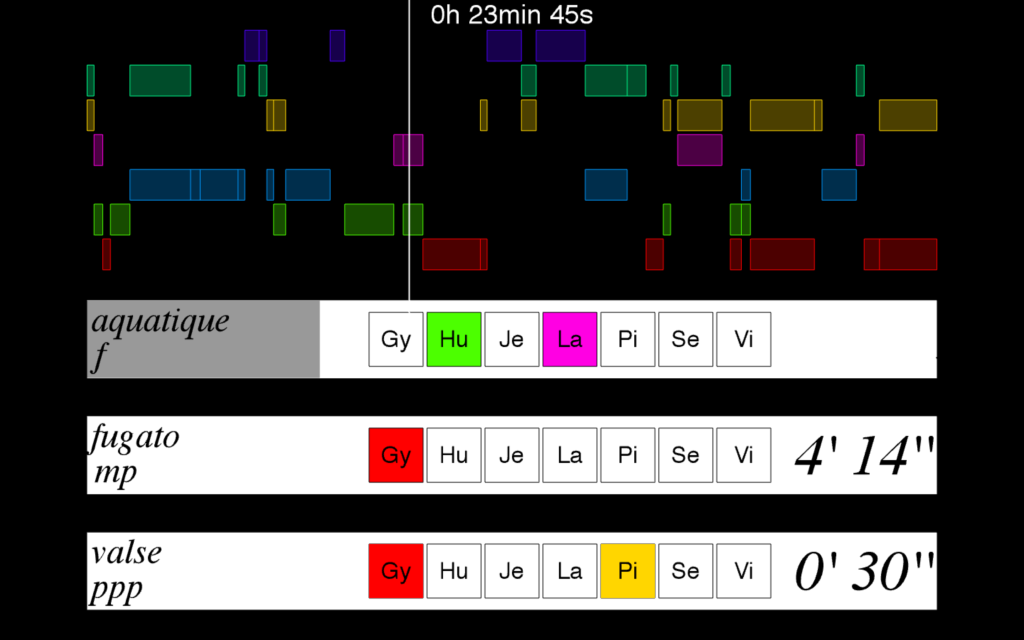
  • a real-time “conductor” displaying the score during live performance

Its name refers to both John Cage and John Doe.

John-scoreGenerator
Random score generation panel
John, conductor Max screenshot
The conductor screen, with countdown and active players

The original development was made with Max, then later reworked to a reactive web app.

Le phonétogramme — an interactive installation for voice analysis

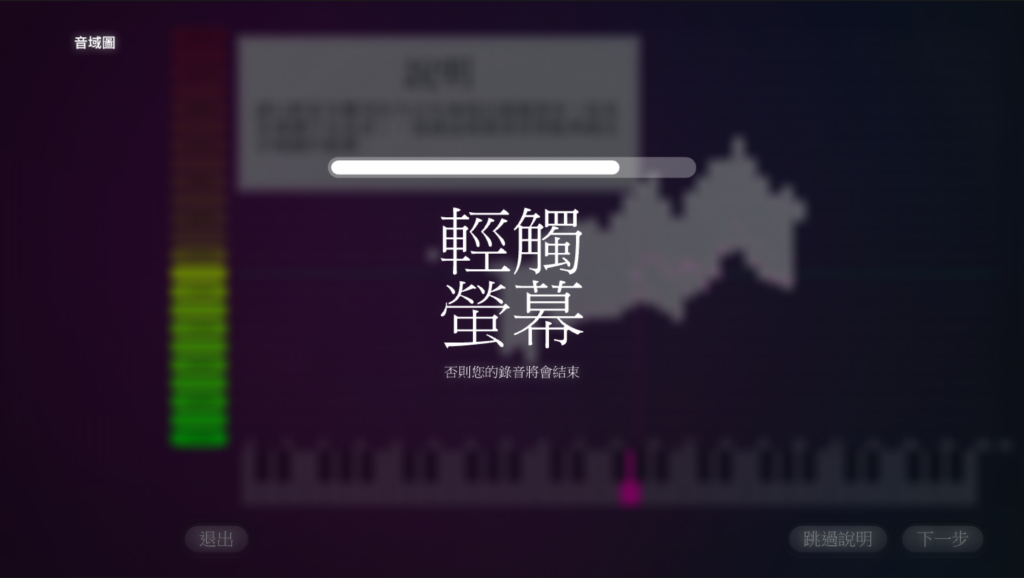
Le phonétogramme is an interactive audio-visual booth created and developed for the “Cité des Sciences” museeum in Paris. It consists in a graph showing the pitch versus the loudness of a voice. It shows various characteristics of one’s voice, including the ambitus, the change of amplitude at vocal register shifts, and possible voice disorders.

The installation involved a multitouch screen to control the multilingual app for the Cité des Sciences audience. A distance sensor was also used to ensure the distance between the user and the microphone was correct. All the graphics and sound interaction design was made with Cycling’74 Max.

It was a challenging thing to design the UI with Max/jitter, but a good opportunity to test the limits of what could be achieved there. This project triggered the development of the MP.TUI package.

A snapshot from the chinese interface of the Phonetogram app.

Computer graphics and multimedia production for the exhibition “La voix, l’expo qui vous parle”.
Client : Cité des Sciences & de l’Industrie

drawing app for oXc by Pierre Sauvageot

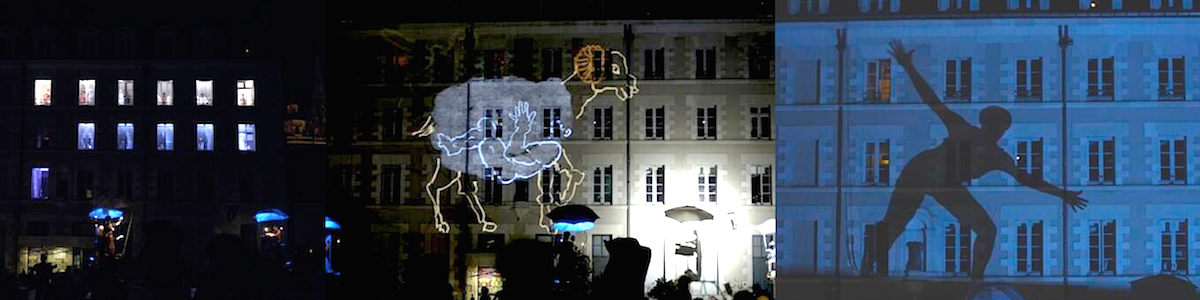
Custom drawing application designed for the show oXc by Pierre Sauvageot and Lieux Publics, projected live onto the facade of a building.

This is not about representing the Odyssey, but about immersing oneself in the language, the voices, the text, the images, the myths, the poetics, the instrumental colors, the sounds of the elements.

For this, there is no Ulysses or Calypso, no Cyclops or Nausicaa, but a series of singular, unique protagonists who monologue, recite, suggest, comment, and interact, each in a very specific form: song, drawing, shadow, burglar, facade chorus, crew.

Pierre Sauvageot offers us a magical and poetic interpretation of this work, written more than 2,000 years ago, a sonorous and humorous one, incredibly relevant today.

 
Production: Lieux Publics / Pucemuse

filigram

filigram is an app to draw filigrams.

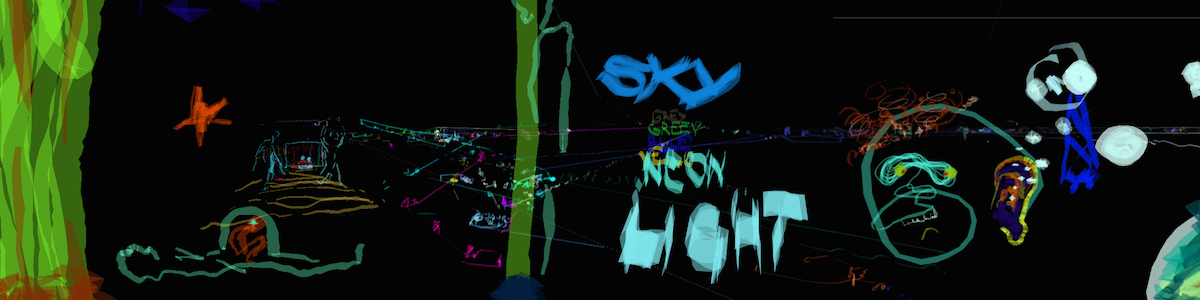
filigram is an expressive tool based on drawing gesture, gathering on the same canvas doodles made by people of different cultures in various contexts.

Filigrams are hand-drawn drawings made on a 2D surface, in a 3D world. Thanks to computers memory, this virtual “sheet of paper” becomes infinitely wide and allows for navigating inside the drawings.

This app was made originally made as a public-space installation where people could share a collective experience of drawing on the same canvas. Perspectives on others’ drawings sometimes leads to graphical compositions that could only be seen from a specific point in the virtual space, somehow like the paintings by Felice Varini.

filigram was shown during:

Art4Lux, Abbaye de Neumunster, Luxembourg (Lu), sept. 2007
Net User Conference 2007 , Pleven Hovel, (Bg), july 2007
– at ArtHostel Sofia (Bg), june 2006
– in Istanbul (Tr), july 2007
Mobile Studios , Batenberg Square, Sofia (Bg), june 2006
TheUpgrade! Skopje (Mk), june 2006
TheUpgrade! Sofia (Bg), june 2006

with support from:

Inter-Space Media Art Center
Pépinières européennes pour jeunes artistes.
Puce Muse

Originally developped with Max, Filigram has been implemented in Java/Processing for availability in the browser, and OpenFrameworks for iOS/android support. Now outdated, the code is being refactored before moving to an open source repository at GitHub. Please contact if interested in the meantime.

filisplash

media

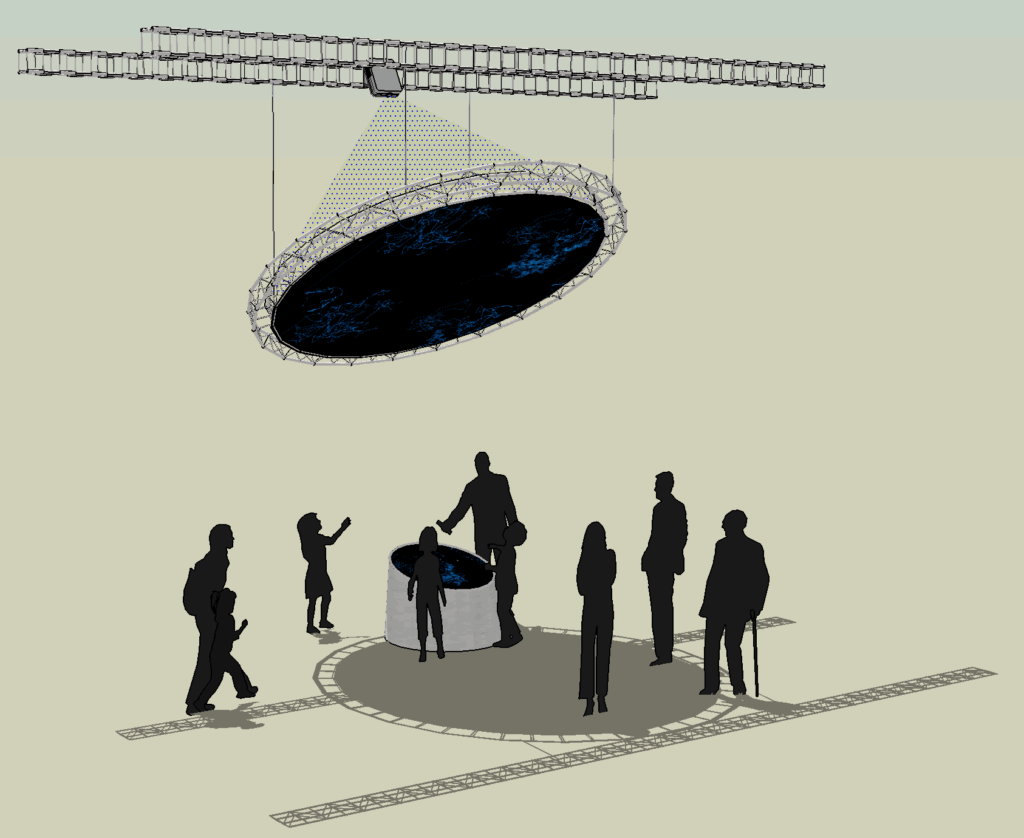
Installation proposal for Filigram
Installation setup proposal (2006)

Radio roulette / Atelier de Création Radiophonique

Development of a “radio-roulette” Max patch for the “Atelier de Création Radiophonique”. The application is receiving a set of live radio streams across Europe (from the amazing audio signal matrix at the Maison de la Radio, before it was all over network but still a patch thing!).  The app then let one “launch” the roulette and is wheeling in a round-robin across the various radio streams.It was used live during the radio show, as a means of including random chunks of sounds aired in the European Union at that precise moment.

Client : Atelier de Création Radiophonique – France Culture

RADIO DAY : DÉSIRS D’EUROPE © Radio France

On the occasion of the “European Day of Culture and Radio”, France Culture’s “Atelier de Création Radiophonique” presents an exceptional live, multi-channel broadcast from studio 105 of the Maison de la Radio, and gives the floor to the “New Europeans” (i.e. the 10 new member countries of the Union) to identify their desires for Europe: what Europe do we want and how?

Conceived as a sonic journey through the radio universes of this new Europe, our program features Proto Radio in Cyprus, Vikkeradio in Estonia, Radio Petofi in Hungary, Lativijas Radio 1 in Latvia, Rtvslo 1 in Lithuania, Radio Malta in Malta, Radio Regina in Slovakia, Radio A1 in Slovenia, Radio 2 in Poland and Radio Vltava in the Czech Republic, and connects live to their programs broadcast in the same time slot as our program, namely from 10:45 p.m. until midnight.

This unique program/performance will be punctuated by reports (from Lithuania, Slovenia, Latvia, and Cyprus) and a series of testimonies gathered from French artists who have worked in one of these countries: Martine Franck (photographer) in the Czech Republic, Patrick Zachmann (photographer) in Hungary, and Eléonore de Montesquiou (visual artist) in Estonia—all contextualized by Bernard Stiegler (philosopher, director of IRCAM) and Yves Mény (political scientist and president of the European University Institute in Florence). No B-side.

Broadcast on Sunday, October the 16th, 2005,  from 10:45 to midnight.

Listen to the archived podcast:
https://www.radiofrance.fr/franceculture/podcasts/atelier-de-creation-radiophonique-10-11/radio-day-desirs-d-europe-7311783